

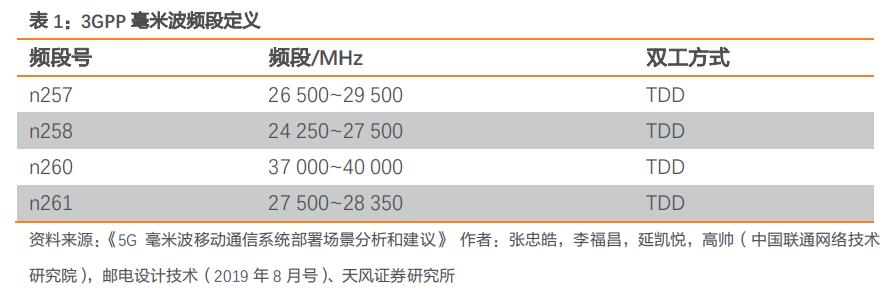
At present, the United States, South Korea, Japan and other countries have successively completed the division and auction of 5G high-frequency spectrum. China has currently disclosed the experimental frequency bands (24.75 ~ 27.5GHz and 37 ~ 42.5GHz), but the specific plan of the millimeter wave spectrum has not yet been officially released. .
China's millimeter wave has basically completed the verification of key technologies, and is expected to be commercialized by 2020. The circuit board factory was informed that the Ministry of Industry and Information Technology of China approved in 2017 the 24.75 ~ 27.5 GHz and 37 ~ 42.5 GHz frequency bands for use in China's 5G technology R & D millimeter wave experimental frequency bands. Three phases of work have been carried out. Operators and equipment manufacturers have accelerated the millimeter wave verification. Specifically, China Unicom completed the multi-vendor 5G millimeter wave base station functional verification in April 19th, and China Mobile also completed 5G in July of the same year. The verification of millimeter-wave key technologies is advancing the verification of system performance and standard solutions. 5G millimeter-wave commercial deployment is planned for 2022. As of the end of October, Huawei, ZTE, and Nokia Bell three system manufacturers have all completed the 2019 millimeter-wave key technology tests. The main functions, design, and field performance testing work are expected to be quickly commercialized after the specific millimeter-wave spectrum plan is released.
AiP is currently the main solution for smart phone millimeter wave antennas: shortening path loss, high cost performance, and meeting miniaturization requirements. The main considerations / influencing factors for the design of 5G millimeter wave antennas are: middle frame design / materials, high overall screen ratio, transmission path loss between RFIC and millimeter wave antenna arrays, millimeter wave antenna array materials, etc. Antenna solutions include: AoB, AiP, AiM, AoC, AiP and other solutions. Taking comprehensive consideration of cost, yield, loss, miniaturization and other factors into consideration, the current major solution for millimeter-wave antennas is AiP, which has been used in Samsung Galaxy S10 5G mobile phones released for mass production.
AiP = RF IC + Antenna: AiP is a technology based on packaging materials and processes that integrates antennas and chips in a package to achieve system-level wireless functions. It is based on SiP (system in package) and uses IC carrier boards to perform multiple functions. Chip SiP system-level packaging. The AiP process mainly includes LTCC (low temperature co-sintered ceramic), HDI (high-density interconnection) and FOWLP (wafer-level fan-out packaging). In addition to using advanced packaging technologies (such as flip chip, TSV, system-level packaging, etc.), AiP also needs to use LCP materials in the internal layer as FPC boards to reduce signal interference, reduce path loss, and improve signal transmission capabilities. .
Advantages: 1) Reduced path loss: AiP is a technology that integrates the antenna and chip in a package to achieve system-level wireless functions, which shortens the distance between the chip and the millimeter wave antenna array and reduces transmission path loss. 2) Cost advantages, mature process, and miniaturization trend: Although the AoC technology solution can greatly reduce the size of the antenna, it needs to be unified in semiconductor materials and processes, and combined with other components in a single chip, manufacturing costs High, more suitable for applications in the terahertz band. Compared with the AoC solution, in the frequency band between 1-10mm of 5G millimeter wave, the size of the on-chip antenna can be smaller than the general chip package. AiP integrates the antenna into the chip, which can simplify the system design, which is conducive to miniaturization and low cost. cost.
Specific AiP module solutions: Two millimeter-wave antenna modules, QTM052 and QTM525, are currently introduced with AiP antenna packaging technology to reduce the thickness of mobile phones and PCB area, and replace the traditional decentralized design of antennas and RF modules. The millimeter wave antenna module integrates: a radio frequency transceiver, a radio frequency front end, a radio frequency back end, a power management chip and a phased antenna array.
We judge that a single machine needs 2-4 AiP modules to ensure the transmission and reception of the millimeter wave frequency band and avoid the "antenna gate" event. Due to its high integration and scarce supply, the current unit price of AiP is high at $ 14-16. According to design suggestions: AiP is best placed on the upper and lower left and right side edges of the phone (to avoid interference with internal components). At the same time, in order to avoid metal shields, AiP needs to be demetallized.
The industry chain tracked that the new frame of Apple's new machine is expected to add metal removal processes such as digging, punching holes, injection molding, covering sapphire, and glass. It is expected that AiP will be configured for demetalization. It is determined that Apple will launch 5G mobile phones (millimeter wave, Sub-6G). Look specifically at the millimeter wave antenna solution:
1) If millimeter wave antennas are not sold separately, Apple millimeter wave antennas are expected to purchase 1-2 millimeter wave AiP complete modules;
2) If millimeter wave chips can be purchased separately, it is expected that one of the AiP modules will use the millimeter wave chip + LCP transmission line / antenna solution, which is expected to make good use of PCB suppliers.